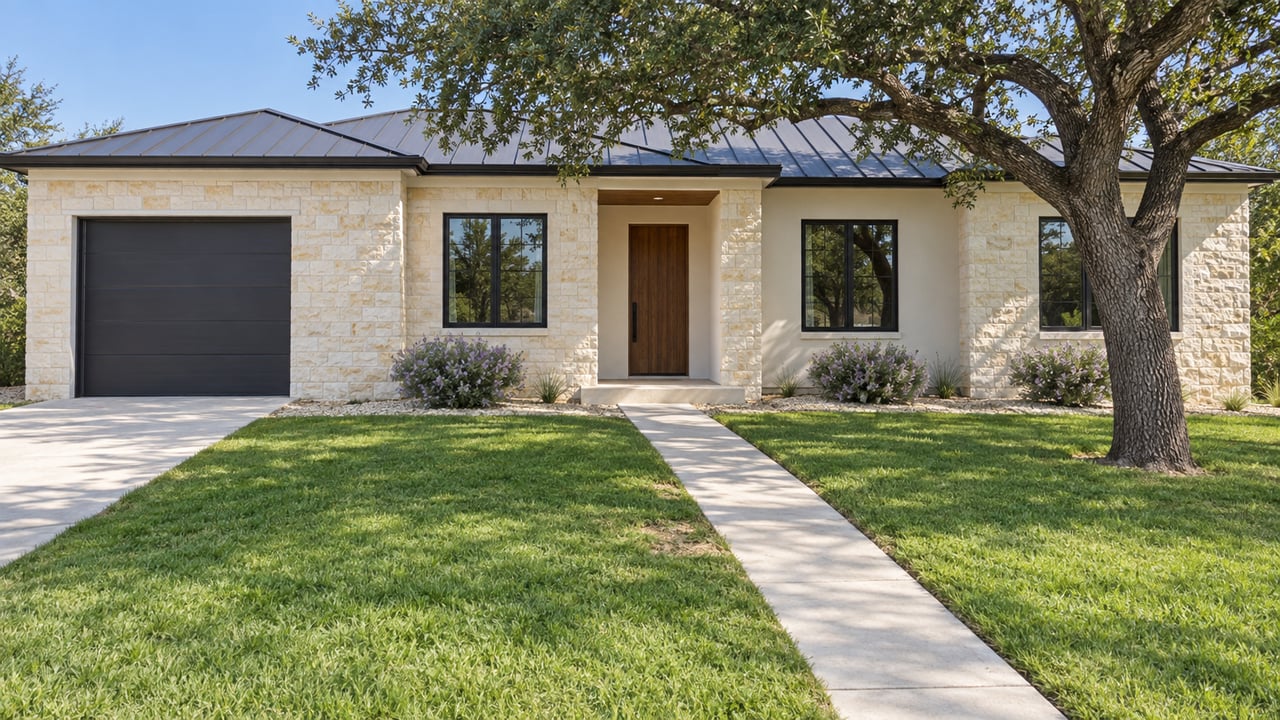
Scroll listings for land outside Castroville and the pattern repeats. An 11-acre tract off FM 471 advertised as "escape to serene country living." A 27-acre stretch with half a mile of Potranco Road frontage, pitched as a rare development play. A 20-acre parcel tagged simply "Ag Exempt," as if that phrase alone were the closing argument. Compare any of those per-acre prices to a finished homesite inside Chesmar Homes' Potranco Oaks, on Grace Avenue between Castroville and San Antonio, and the acreage looks like the obvious bargain.
It usually isn't. The gap between what raw land costs and what a builder charges for a platted lot has less to do with dirt and more to do with a tax status that ends the moment someone builds on it.
The per-acre math that starts every comparison
Land listed for sale in and around Castroville currently averages roughly $638,000, or about $187,000 an acre, based on the tracts actively on the market as of this writing. Zoom out to Medina County as a whole and the average drops to about $25,000 an acre. The difference isn't really about soil or drainage. It's proximity. Land close to Castroville sits inside a growth corridor where subdivisions like Potranco Oaks are already pulling infrastructure and rooftops westward, while land deeper in the county is priced for cattle, hay, and hunting leases.
That context matters, because most of the acreage carrying the higher near-town price tag is still being taxed like the cheaper, deeper-county land. A large share of it holds a Texas agricultural, or 1-d-1, valuation, which taxes the property on what it can produce rather than what it would sell for. It's a common enough selling point that "ag exempt" shows up in listing after listing, right alongside acreage and road frontage, as a reason the carrying cost looks so light.
The bill that shows up after closing, not before it
That light tax bill is conditional, not permanent. Under the Texas Constitution and Tax Code, land loses its 1-d-1 valuation the moment the qualifying agricultural use ends on the affected portion, and building a home is the textbook trigger. When that happens, the county recalculates what the owner would have paid at full market value and bills the difference for each of the previous three years the land carried the lower valuation, according to the Texas Comptroller's guidance on agricultural and timber appraisal.
Two details change the size and shape of that bill in ways worth knowing before an offer goes in.
First, the lookback window is shorter than it used to be. House Bill 1743, effective September 1, 2019, cut the rollback period from five years to three. House Bill 3833, effective June 15, 2021, went further and removed the interest charge that used to compound on top of the recaptured tax. A fair number of guides circulating online still describe the older five-year, interest-bearing version. It hasn't been the law for several years.
Second, LandQuire explains that the rollback applies to the acreage that actually changes use, not automatically to the whole tract. Building a house on two acres of a twenty-acre parcel typically triggers the recapture on those two acres while the remaining eighteen can keep the agricultural valuation, as long as a qualifying use continues there. For a buyer planning to build on part of a larger property and leave the rest in pasture or hay, that distinction is the difference between a manageable bill and a much larger one.
None of this makes the acreage a bad purchase. It makes the "low taxes" line in the listing a number with an expiration date tied to the buyer's own construction plans, not a fixed feature of the land.
What the price at Potranco Oaks has already absorbed
Set that mechanism next to a finished lot inside Potranco Oaks and the builder's price starts to read differently. Chesmar's masterplan there starts from $468,990, with homesites in its Potranco Oaks section running from the $500s into the $800s and homes at The Reserve at Potranco Oaks priced between $465,990 and $539,990. Davidson Homes builds alongside Chesmar in the same community on lots running roughly four-tenths to seven-tenths of an acre. HOA dues across the different sections run about $150 to $175 a year, low enough that they barely register against the home price.
None of those prices carry a rollback contingency, because the developer already converted the ground, platted it, ran the roads and utility lines, and settled whatever tax exposure the raw acreage once carried, all before a single floor plan went up for sale. The builder priced that work into the lot the same way it priced in the slab and the roof. A buyer writing an offer on a finished Potranco Oaks homesite isn't choosing between land and a tax risk. That choice was already made, upstream, by someone else.
Reading the comparison the way it should be read
| Raw acreage near Castroville | Finished homesite, Potranco Oaks | |
|---|---|---|
| Price basis | Roughly $187,000/acre average, current listings | Lot-and-home packages from the $460s to $840s |
| Typical lot size | Varies widely, several acres and up | Roughly a quarter-acre to seven-tenths of an acre |
| Tax status | Often still ag-valued, subject to rollback on any developed portion | Already converted, platted, and taxed as residential |
| What's already done | Usually nothing beyond fencing or a well | Roads, utilities, platting, HOA structure in place |
| What still needs checking | Current use code with the county, market vs. ag value gap, whether adjoining acreage keeps its valuation | Builder contract terms, lot premium, HOA obligations |
The right comparison isn't dollars per acre. It's what has already been resolved against what a buyer is choosing to take on. Raw acreage can still be the better financial move for someone who wants five acres and a barn and no HOA, but that decision deserves the same scrutiny as any other line item, not a glance at the listed tax bill.
What to check before an offer on acreage
Before writing an offer on land near Castroville that's marketed as low-tax or ag-exempt, a buyer planning to build has a short, specific list worth working through with the Medina County Appraisal District:
- Confirm the parcel's current special-use code and whether it's actually enrolled in 1-d-1, rather than assuming the listing description is accurate
- Ask what the market value versus the productivity value looks like on the appraisal roll, since that gap is the rollback exposure
- If building on only part of a larger tract, confirm in writing whether the untouched acreage can keep its valuation once the homesite is carved out
- Budget for three years of recaptured tax on the converted portion, understanding that no interest applies to that recapture under current law
That last point is the one worth sitting with. On land appreciating as fast as the ground around Castroville, three years of recaptured tax on even a modest home site can still run into five figures. It's a real cost. It's also a knowable one, which is more than can be said for a lot of what shows up as a surprise at closing.
A few questions that come up often
Does selling agricultural land trigger the rollback by itself? No. A sale alone doesn't end the valuation if the new owner keeps up a qualifying agricultural use. The trigger is the change in use, not the change in ownership.
Who actually owes the rollback tax, the buyer or the seller? According to Daughtrey Law, Texas law puts the bill on whoever owns the land when the qualifying use ends. In practice, that's frequently the buyer, since the use typically changes after closing when construction starts.
Whether the right move is a finished lot at Potranco Oaks or a raw tract further out, the comparison holds up better once the tax status of the land gets the same attention as the acreage and the view. If you're weighing that decision for a piece of Castroville-area land or a lot inside one of the communities nearby, Alyssa Oliver can help you run the numbers before you write the offer, not after.
This article is general information, not legal, tax or financial advice. Consult a qualified professional about your situation.